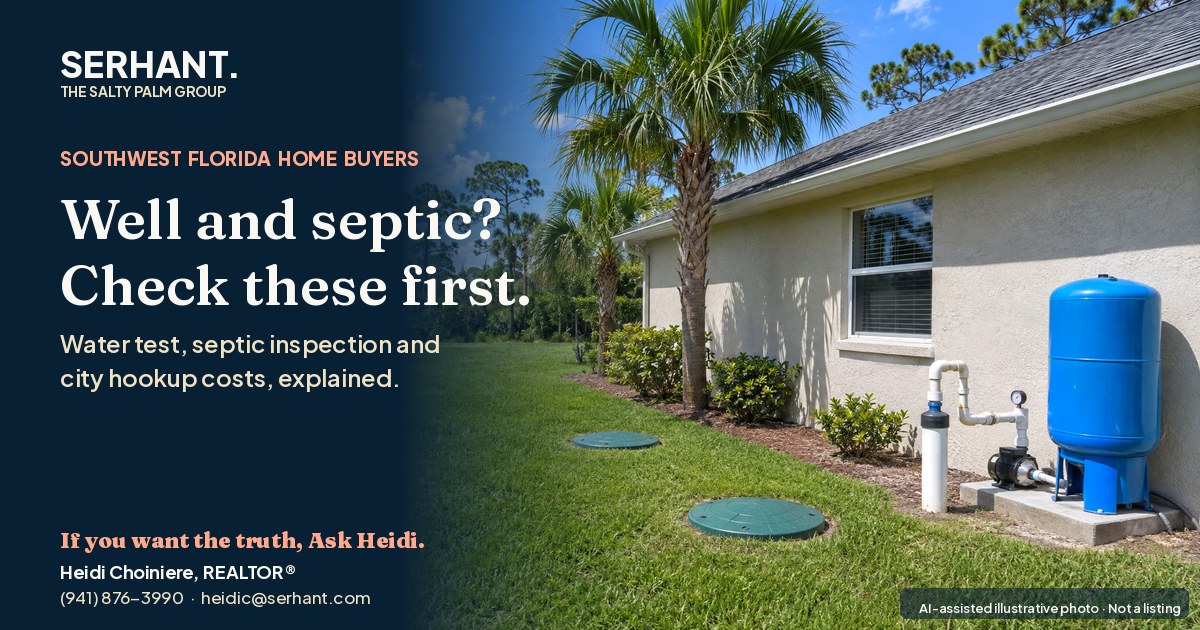
Plenty of great homes in Southwest Florida run on a private well and a septic tank instead of city water and sewer, especially in North Port and parts of Charlotte County. That’s not a deal breaker. It just means a few extra checks before you buy. Florida doesn’t require a well water test or a septic inspection when a home sells, so those checks are on you, and the time to do them is during your inspection period. Then find out whether city water or sewer is coming to the street, because a required hookup can come with a real bill.
If you’re moving from somewhere where every house had a water bill and a sewer line, this can feel like a whole new language. Here’s what I want every buyer to know, as of November 26, 2026.
The short answer
- Check the specific address. The listing, the neighbors or "the whole street is on city water" are not proof. The utility and the county health department are.
- Test the well water. The Florida Department of Health recommends testing for coliform bacteria, nitrates and lead when you buy a home with a well. The state doesn’t require it.
- Inspect the septic. Florida law says a government can’t require a septic inspection at the point of sale, so hire your own during the inspection period.
- Pull the records. Septic permits, well history and any maintenance contract tell you a lot about what you’re buying.
- Ask what’s coming. If central water or sewer becomes available, Florida law generally requires septic owners to connect within 365 days of written notice, and connection fees can run into five figures.
Step 1: Find out what this house actually has
Start with the source, not the listing remarks.
- North Port: call North Port Utilities at (941) 240-8000 or email [email protected] and ask about the exact parcel: water, sewer, both or neither.
- Charlotte County (Port Charlotte, Punta Gorda, Englewood side): Charlotte County Utilities Engineering Services is at 941-764-4300, Option 3, and can confirm availability and connection costs for a property.
- Septic records in Sarasota County: the Florida Department of Health in Sarasota County has digitized septic permits and records from 1972 to today in its online Septic Search, or you can call 941-861-6133.
Why it matters: the answer changes your inspections, your monthly costs and what could land on your desk after closing.
Step 2: Test the well water
Here’s the part people skip. The Florida Department of Health says plainly that the state has no requirement for well sampling when a private home is sold. Its general recommendation is to test a private well for coliform bacteria, nitrates and lead, and other tests may make sense depending on the well’s location, depth and condition. Once you own it, the department recommends testing for bacteria and nitrate every year and lead about every three years.
What I’d do on a home with a well:
- Use a state-certified lab. The Department of Health says to always use one so the results are accurate. In Sarasota County, the health department sells a do-it-yourself kit for $20, and staff can sometimes collect the sample for an additional $40 (as listed November 26, 2026).
- Ask for the well’s history. The state’s homeowner guide to wells says a copy of the well log may be available from the seller, the company that drilled the well or the local health department.
- Ask about equipment. Pump, pressure tank and any water softener or filter. The same guide says treatment devices should be regularly maintained, so ask when they were last serviced.
- Ask about yield. The guide suggests checking the well’s capacity, and your well professional or the health department can tell you what’s typical in the area.
If anything comes back off, your county health department can help you read the results and talk through next steps.
Step 3: Inspect the septic, because no one else will
This is the part that surprises people. Under Florida Statute 381.0065(4)(x), a government entity may not mandate a septic inspection at the point of sale in a real estate transaction. That’s the law protecting the transaction from extra red tape, but it also means nobody checks the system for you.
So during your inspection period, I want you to have a qualified septic contractor look at it. Things worth asking about:
- The permit and the system type. The same statute says a septic permit transfers with the title when the property sells. Pull the record so you know what was approved and when.
- Aerobic or performance-based systems. In Sarasota County, these need an operating permit renewed every two years plus a maintenance contract with an approved maintenance entity, which must inspect and service the system at least twice a year. Ask the seller for the current permit and contract, and plan for that ongoing cost.
- Maintenance history. The U.S. EPA says a typical household septic system should be inspected at least every three years and the tank is typically pumped every three to five years. Ask when it was last pumped.
- Repairs. In Sarasota County, a failing system needs a repair permit before work starts, and new or modified systems must be designed by a professional engineer under county code. That’s worth knowing before you assume a repair is a quick fix.
Step 4: Ask whether city water or sewer is coming
This is the money question.
What state law says. Under Florida Statute 381.00655, the owner of a working septic system generally must connect to an available public or investor-owned sewer within 365 days after written notice that it’s available. The utility is supposed to send advance notice at least a year before service becomes available. A system that needs repair can be required to connect within 90 days of notice from the state.
North Port, as of November 26, 2026:
- City water. The city’s page says North Port City Code Section 78-60(a) requires properties with access to central water to connect within 365 days of notice. The cost listed there to connect a single-family home was $12,300.06 (as of November 2025), plus your own plumber and backflow preventer. The same page now says the City Commission paused the mandatory water connection that affected about 450 owners and directed staff to work on making it voluntary. Treat that as a moving target and confirm the current status with the city before you buy.
- City sewer. North Port’s long-term wastewater expansion plan starts with the Blue Ridge-Salford North area, 1,583 properties, with an estimated 12 to 15 years to complete that first neighborhood. The city lists an early-incentive maximum of $4,045 for wastewater or $6,655 for water and wastewater during construction, with a 30-year payment plan and a hardship program, and says the full cost without incentives could be up to $35,000 based on similar projects.
Charlotte County, as of November 26, 2026:
- Charlotte County Utilities’ July 2026 low-pressure sewer FAQ lists connection fees totaling $17,596 for the average home, and says it doesn’t currently offer a payment option for mandatory connections. A property in a mandatory area gets a certified letter and then has 365 days to pay and connect.
- In some project areas, sewer costs are paid through a special assessment on the annual tax bill. The county says that assessment stays with the property when it sells. In the Ackerman project, for example, the county lists $575 a year and in September 2026 directed staff to extend the assessment period to keep it at that amount.
So before you’re under contract, ask the seller whether they’ve received any connection or availability letters, and read the non-ad valorem assessments on the most recent tax bill. My guide to when property taxes are due explains what those line items are.
Is a well and septic cheaper to own?
It depends, and I’d rather show you the real numbers than give you a slogan. With a well and septic, you skip a monthly water and sewer bill, but you own the pump, the tank, the testing and every repair. With city service, you get a monthly bill. Charlotte County’s FAQ, for instance, estimates about $75.95 a month for sewer-only service at 4,000 gallons of use (rates subject to change).
The North Port Utilities page also points out that you can keep your well for irrigation after connecting to city water, just not for drinking water.
Put it all in your budget next to insurance, HOA and CDD costs before you fall in love with a house.
Where your buyer’s agent earns their keep
A good buyer’s agent does more than open the door. On a home with a well and septic, I want us to:
- Confirm utilities with the source before you write an offer.
- Schedule the well test and septic inspection early, so results come back inside your inspection period.
- Ask the seller about letters, permits, maintenance contracts and recent repairs.
- Line up the right professionals, from a septic contractor to a certified lab.
If you’re shopping in North Port, also read my guide to checking zoning before you buy a lot, and if you’re comparing contract forms, here’s FAR/BAR vs. AS IS. Your contract’s inspection terms control what you can do with the results, so for legal questions, talk with a Florida real estate attorney.
Common questions
Is a well and septic home harder to sell later? A buyer will ask the same questions you’re asking now. Keep your water test results, pumping receipts and permits in one folder and you’ll have answers ready.
Can I connect to city water now if it’s available? In North Port, the city’s page says owners who want to opt in voluntarily will have a capped cost to be set by the Commission. Call North Port Utilities for the current details.
Does a new septic system mean no worries? It helps, but still pull the permit, ask what type it is and find out whether it needs an operating permit or maintenance contract.
Should I test the water even if it tastes fine? Yes. Taste can’t tell you what a lab test can, and the state recommends testing either way.
Let’s talk about your move
Well, septic, city water or sewer, none of it should be a surprise after you get the keys. When we sit down for a buyer consultation, I’ll walk you through what a specific home really runs on and what it could cost you down the road. Start at thesaltypalmgroup.com or call or text (941) 876-3990.
If you want the truth, Ask Heidi.
Sources
Checked November 26, 2026. This is general information, not legal, health or engineering advice. Your utility, county health department and licensed professionals have the final word on a specific property.
- Florida Statute 381.00655, Connection of existing septic systems to central sewer (2026)
- Florida Statute 381.0065, Onsite sewage treatment and disposal systems (2026)
- Florida Department of Health: Private Well Water Testing
- Florida Department of Health: Homeowner’s Guide to Your Well (PDF)
- Florida Department of Health in Sarasota County: Test Your Water
- Florida Department of Health in Sarasota County: Onsite Sewage Disposal and Septic Search
- Florida Department of Environmental Protection: Onsite Sewage Program
- U.S. EPA: How to Care for Your Septic System
- City of North Port: Mandatory Utilities Connection
- City of North Port: Wastewater Long-term Expansion Plan
- Charlotte County Utilities: Sewer Service
- Charlotte County Utilities: FAQs, Low Pressure Sewer (July 2026, PDF)
- Charlotte County: Ackerman Wastewater Expansion
Related guides from the journal
SERHANT.
Heidi Choiniere, REALTOR®
FL License #SL3445168
The Salty Palm Group
(941) 876-3990 · [email protected]