The short answer
Maybe it is required, and it is almost always worth pricing. Most homeowners policies do not cover flood. You are generally required to carry flood insurance if the home is in a FEMA high-risk Special Flood Hazard Area and you have a federally backed or federally regulated mortgage. Lenders can also require it elsewhere, and Florida’s Citizens Property Insurance Corporation is phasing in its own flood requirement, which reaches all of its personal residential policies with wind coverage (other than condo unit-owner policies) on January 1, 2027.
Even when it is optional, a flood quote belongs in your budget before you commit to a home, not after. As of November 10, 2026, the federal flood program is authorized only through December 11, 2026, so if you are buying soon, start the flood conversation now.
Doesn’t my homeowners policy cover water damage?
Not flood damage, in most cases. FEMA’s FloodSmart site says most homeowners and renters policies do not cover flood, and Florida’s own flood disclosure form for home sales opens with the same warning: “Homeowners’ insurance policies do not include coverage for damage resulting from floods.” A flood policy is a separate purchase.
The cause matters. FEMA gives an example: an NFIP policy would cover water damage from a sewer that backed up during a heavy rainstorm, but not a backup caused by clogged pipes. NFIP policies also leave out some things no matter the cause, including property outside the insured building such as landscaping, septic systems, decks, patios, fences and swimming pools, temporary housing and additional living expenses, and cars.
Under the NFIP, building coverage goes up to $250,000 and contents coverage up to $100,000 for a home, and FEMA says building and contents are typically purchased separately with separate deductibles. If you want contents covered, ask for it by name.
When is flood insurance actually required?
- Your mortgage. If the home is in a Special Flood Hazard Area (zones beginning with A or V) and you have a government-backed mortgage, FEMA says flood insurance is required. Florida’s Office of Insurance Regulation describes the rule as applying to mortgages from federally regulated or insured lenders. FEMA and OIR both note that some lenders require flood coverage outside high-risk areas, so ask your lender early.
- Past disaster aid on the property. FEMA says if a property received federal disaster assistance before, flood insurance is required to qualify for future assistance, and the requirement is tied to the property, not the owner. Buying that home means inheriting the requirement.
- A Citizens policy. If your homeowners coverage comes from Citizens, its flood requirement may apply. See the Citizens section below.
Paying cash? The mortgage rule won’t apply, but the flood risk is the same. That is a decision to make with real numbers, not a reason to skip the quote.
What does my flood zone actually mean?
FEMA’s Flood Insurance Rate Maps sort areas by risk. Zones starting with A or V are high-risk Special Flood Hazard Areas, with V zones adding coastal wave hazard. X (and older B and C) zones are moderate- to low-risk, and D means the risk has not been studied, not that there is none.
“Low risk” is not “no risk.” FEMA’s FloodSmart site says that over the past 10 years nearly one-third of NFIP claims came from outside high-risk zones. Heavy rainfall, drainage and storm surge don’t follow map lines. Charlotte County’s flood page, for example, notes that flooding can come from hurricanes, heavy rain, king tides and rain upstream that raises the Peace and Myakka rivers.
Maps also change. FEMA recommends checking for updates, because a new map can change both requirements and cost. If an updated map moves a home into a high-risk area, FEMA describes a newly mapped discount for policies bought or renewed within 12 months of the change.
Should I look at NFIP or private flood insurance?
| Question | NFIP (federal program) | Private flood |
|---|---|---|
| Who sells it? | Participating insurance companies and agents. FEMA says NFIP rates are the same no matter which provider sells the policy. | Insurers that write their own flood coverage. OIR publishes a list of companies eligible to write primary or excess flood insurance in Florida. |
| Limits | Up to $250,000 building and $100,000 contents for a home. | OIR says private insurers may offer higher limits or broader coverage, and excess policies can sit above an NFIP policy. |
| Coverage rules | The Standard Flood Insurance Policy, with the exclusions above. | Florida Statutes section 627.715 defines several private flood types. OIR explains that standard, preferred and customized types must be at least as broad as NFIP coverage; flexible and supplemental types can differ. Read the form. |
| Waiting period | Generally 30 days, with exceptions (below). | Set by the policy. Ask for it in writing. |
| Lender acceptance | Meets the federal requirement. | Ask your lender to confirm it accepts the specific policy before you bind it. |
Neither is automatically better. Compare coverage, limits, deductibles, exclusions, cancellation terms, the waiting period and what your lender will accept, along with the premium.
A timing note for late 2026: Congress renews the NFIP’s authority in short extensions. FEMA says the current extension runs to 11:59 p.m. on December 11, 2026. The Congressional Research Service explains that if authority lapses, new NFIP policies can’t be issued, while existing policies stay in force through their term. The program lapsed from October 1 to November 12, 2025, and again from February 1 to 3, 2026. If you are closing near that date, ask your insurance professional and lender for a plan that works whether or not Congress extends it.
When does flood coverage start?
FEMA says NFIP coverage generally takes effect 30 days after purchase, with four exceptions:
- No wait if you buy it while making, increasing, extending or renewing a mortgage.
- No wait for coverage changes made when you renew.
- One day if the property was newly mapped into a high-risk zone and you buy within 12 months of the map update.
- One day for certain flooding after wildfires on federal land, bought within 60 days of containment.
A cash buyer usually won’t fit the mortgage exception, and a private policy may follow different rules. Have your licensed insurance professional confirm the effective date for your situation. FEMA also notes you may be able to assume a seller’s existing NFIP policy, which can affect both timing and price.
Does Citizens Property Insurance require flood coverage?
If Citizens is your homeowners insurer, likely yes, or soon. Under Florida Statutes section 627.351(6)(aa), Citizens personal residential policyholders must carry flood insurance as a condition of coverage, phased in like this:
- In a FEMA Special Flood Hazard Area: required for new policies issued on or after April 1, 2023, and for renewals on or after July 1, 2023.
- Outside it, by dwelling replacement cost: $600,000 or more for policies effective on or after January 1, 2024; $500,000 or more from January 1, 2025; $400,000 or more from January 1, 2026.
- January 1, 2027: all other personal residential property insured by Citizens.
The statute exempts policies that don’t cover wind and condominium unit-owner policies, and says the flood coverage must at least meet the NFIP’s dwelling coverage or the private flood standards in section 627.715. Citizens’ own guidance says the requirement applies to dwelling (Coverage A) rather than contents, that renters are not required to carry it, and that policyholders must provide proof of flood coverage to renew.
If you are buying in early 2027 and expect a Citizens policy, plan for both policies in your budget and your closing timeline.
What does a Florida seller have to tell me about flooding?
Florida Statutes section 689.302 requires a seller of residential real property to give the buyer a flood disclosure at or before the time the sales contract is signed. The current form, as amended effective October 1, 2025, asks whether the seller:
- has knowledge of flooding that damaged the property during the seller’s ownership;
- has filed a flood-damage claim with an insurance provider, including the NFIP; and
- has received assistance for flood damage, including from FEMA.
The form defines flooding to include sustained standing water from rainfall, not just rising rivers or tides. The same 2025 law added flood disclosures for developer sales of residential condominium units and for residential rentals. Read the disclosure carefully, ask follow-up questions in writing, and remember it covers only the current seller’s ownership and knowledge. A Florida real estate attorney can explain how it fits with the rest of your contract.
How do I research flood risk for a specific address?
- Look up the flood zone on FEMA’s Flood Map Service Center, and check the local floodplain tools for the city or county. Your lender’s official flood determination is what counts for the loan.
- Ask for the elevation certificate. FEMA explains that it compares the building’s height with expected flood levels and can help with pricing. Start with the seller, then the local floodplain manager. In Charlotte County, the Building Construction Division keeps elevation certificates for unincorporated Charlotte County and offers a free search, though certificates for homes in Punta Gorda, Florida, are not on file there and older homes may be missing. If none exists, a licensed surveyor, engineer or architect can prepare one.
- Read the seller’s flood disclosure and ask about past claims, repairs and permits.
- Ask about mitigation. FEMA lists steps like elevating utilities and installing flood openings that can reduce damage and may lower NFIP premiums. Ask whether the community participates in FEMA’s Community Rating System, which can bring discounts.
- Get the quote before your inspection or financing deadlines so the number can still shape your decision.
Whether you’re looking along canals in Cape Coral, Florida, or inland in North Port, Florida, run the same steps for every address. A neighbor’s premium or a listing remark is not a quote for your home.
What should I ask my insurance agent?
- What flood zone is this address in, and do you need an elevation certificate to quote it?
- Can you quote both NFIP and private flood, building and contents separately?
- What are the deductibles, limits and main exclusions for each option?
- When would coverage start for my purchase, and does a waiting period apply?
- Can I assume the seller’s NFIP policy, and would that help?
- Will my lender accept this policy? If I expect Citizens for wind, does it meet Citizens’ flood requirement?
- How would an NFIP lapse after December 11, 2026, affect my closing?
- Which improvements, such as raising equipment, could lower my premium?
Your flood checklist
- Look up the FEMA flood zone and any local flood information for the exact address.
- Request the seller’s flood disclosure, elevation certificate and any current flood policy.
- Ask your lender whether flood insurance is required and which policies it accepts.
- Get NFIP and private quotes, including building and contents.
- Confirm the effective date and waiting period in writing.
- If Citizens may be your homeowners insurer, check its flood requirement for your dates.
- Add the flood premium and deductible to your ownership-cost worksheet.
- If you’re closing near December 11, 2026, ask for a backup plan in case NFIP authority lapses.
Common questions
Is flood insurance required if the home is in Zone X?
Not by the federal mortgage rule, which applies to high-risk Special Flood Hazard Areas. A lender can still require it, and a Citizens policy with wind coverage may require it. FEMA recommends flood coverage in moderate- and low-risk zones because they are not risk-free.
Can I buy flood insurance a few days before closing?
If you are buying with a mortgage, FEMA says there is no 30-day wait for an NFIP policy bought in connection with making the loan. Without that exception, NFIP coverage generally starts 30 days after purchase. Private policies set their own rules, so ask the insurer in writing.
Can I keep the seller’s flood policy?
Sometimes. FEMA says a buyer may be able to assume the prior owner’s NFIP policy, which can matter if that policy is not yet at its full-risk rate. Ask the seller for the declarations page and have your insurance professional confirm whether an assignment makes sense.
Will the seller tell me if the home has flooded?
For residential sales, Florida law requires the seller to give a flood disclosure at or before contract signing covering known flood damage during their ownership, flood claims and flood-damage assistance. It covers only the seller’s ownership period and knowledge, so keep doing your own research.
Can Heidi tell me whether a home needs flood insurance?
I can help you pull the flood zone, ask for the elevation certificate and disclosure, and keep the insurance timeline on track. Whether coverage is required, and how much you should carry, is for your lender and a licensed insurance professional to answer. If you want the truth, Ask Heidi.
SERHANT.
Heidi Choiniere, REALTOR®
FL License #SL3445168
The Salty Palm Group
(941) 876-3990 · [email protected]
Keep building your moving plan
Sources and scope
Sources checked November 10, 2026. Laws, program authority and insurer rules change, so check the current requirements for your purchase.
- FEMA FloodSmart: What you need to know about buying flood insurance (coverage, exclusions, waiting period)
- FEMA FloodSmart: Eligibility, mortgage and disaster-assistance requirements
- FEMA FloodSmart: Flood zones and maps
- FEMA FloodSmart: What is a flood?
- FEMA FloodSmart: Elevation certificates
- FEMA Flood Map Service Center
- FEMA: Congressional reauthorization of the NFIP (updated September 28, 2026)
- Congressional Research Service: What happens if the NFIP lapses? (PDF)
- Florida Statutes § 689.302: Disclosure of flood risks to prospective purchaser
- Florida Senate: CS/CS/SB 948 (2025), Flood Disclosures, effective October 1, 2025
- Florida Statutes § 627.351(6)(aa): Citizens flood insurance requirement
- Citizens Property Insurance Corporation: New flood rules (June 4, 2024)
- Florida Office of Insurance Regulation: Flood insurance and private flood writers
- Charlotte County: Flood information
- Charlotte County: Elevation certificates
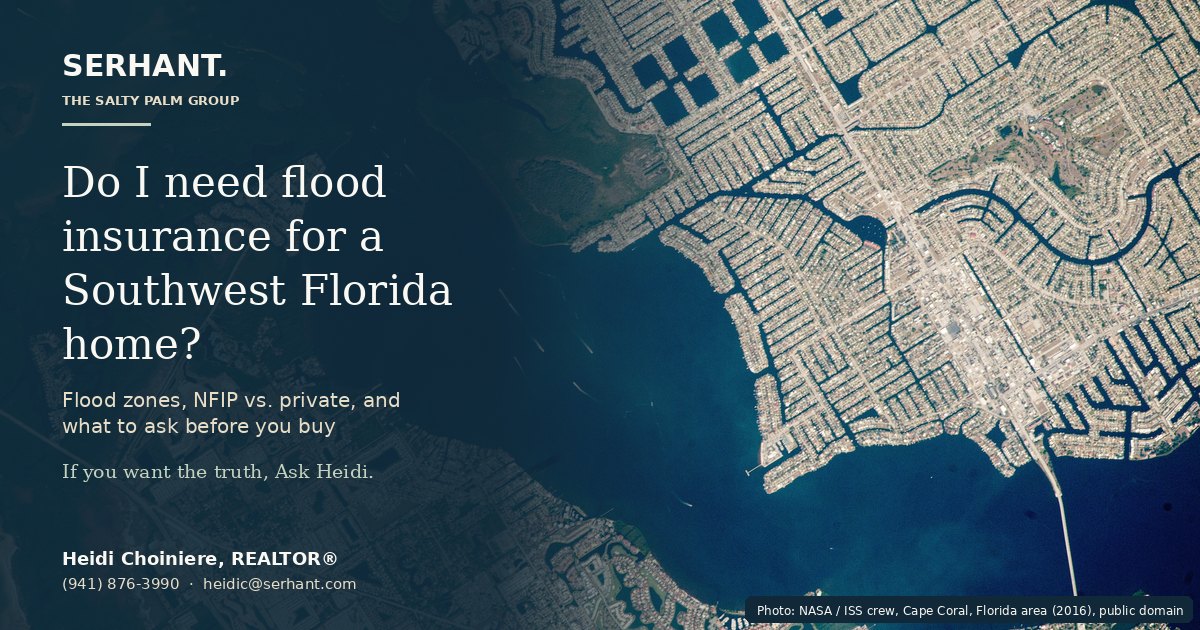
General information only; not insurance, legal or lending advice. Coverage, eligibility, rates and requirements depend on the property, the policy and your lender. Talk with a licensed Florida insurance professional, your lender and, for contract questions, a Florida real estate attorney before deciding. No premium averages or guarantees are implied. Social image: NASA astronaut photograph of the Cape Coral, Florida, area from the International Space Station (ISS047-E-84351, 2016, public domain), not a listing.