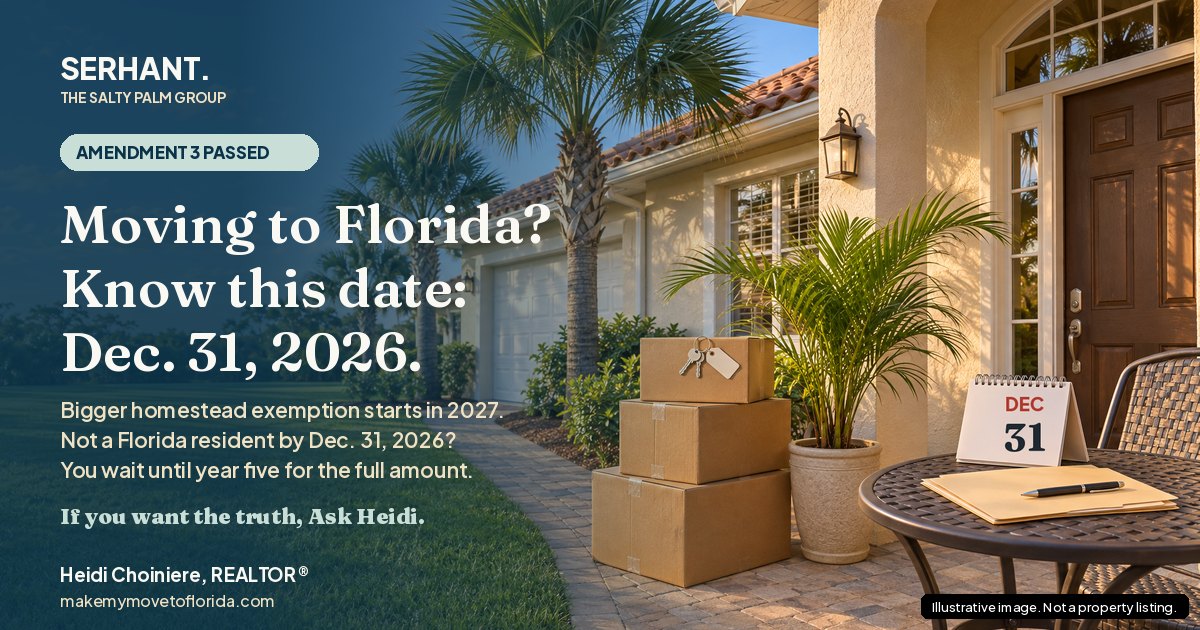
Florida voters said yes to Amendment 3 on November 3, 2026. If you’re planning a move to Southwest Florida, you’ve probably already heard a few versions of what it means, from "property taxes are gone" to "you have to move by New Year’s." Neither one is right. Here’s what actually passed, the one date that matters for newcomers, and what I’d do with that information if I were in your shoes.
The short answer
Starting January 1, 2027, the homestead exemption on non-school property taxes jumps to $150,000 of assessed value, then $250,000 in 2028. School taxes keep the same $25,000 exemption. The catch for people moving here: if you weren’t a Florida resident as of December 31, 2026, you start with a smaller exemption ($25,000 for school taxes and up to $50,000 for everything else) and get the bigger one beginning with your fifth year of homestead. Second homes and rentals get a lower cap on yearly assessment increases, 5% instead of 10%, for non-school taxes.
What did Florida voters actually approve?
Amendment 3 (House Joint Resolution 1-F) passed with 61.98% yes, according to the second set of unofficial returns posted by the Florida Division of Elections. Constitutional amendments need 60%, so it cleared the bar. The Florida Department of Revenue confirmed it was approved in a bulletin dated November 5, 2026. It takes effect January 1, 2027 and first shows up on the 2027 tax roll, which means your November 2027 tax bill.
Here’s the short version of what it does, from the Department of Revenue bulletin and the amendment text:
- Bigger homestead exemption for non-school taxes. Up to $150,000 of assessed value in 2027 and $250,000 in 2028, adjusted for inflation after that.
- School taxes don’t change. The school-tax exemption stays at $25,000.
- A newcomer rule. People who weren’t Florida residents as of December 31, 2026 get the smaller exemption first, and the larger one beginning with their fifth year of exemption.
- A lower cap for non-homestead property. Yearly assessment increases on second homes, rentals and commercial property are capped at 5% instead of 10% for non-school taxes, starting January 1, 2027.
- Limits on how counties and cities can use property taxes. The amendment lists what those dollars can pay for, like public safety, schools, infrastructure and flood control.
Property taxes are not eliminated. The Charlotte County Property Appraiser puts it plainly on its Amendment 3 page: school taxes still apply, and non-ad valorem assessments and fees aren’t touched.
Why December 31, 2026 is the date to know
This is the part that matters most if you’re still up north.
The amendment text gives the full increased exemption to homesteaders generally, then carves out anyone who "had not maintained a permanent residence in this state as of December 31, 2026." If that’s you, here’s how it works, according to the Department of Revenue bulletin:
- You still qualify for homestead once you own the home, live in it as your permanent residence on January 1 and file on time.
- Your exemption is $25,000 for school taxes and up to $50,000 for non-school taxes. That’s roughly the size of today’s exemption.
- Beginning with your fifth year of exemption, you move up to the full non-school amount everyone else gets.
Two details people miss:
- The test is residence, not ownership. The amendment text asks whether you had a permanent residence in Florida as of December 31, 2026. It doesn’t say you had to own your eventual home by then. Exactly how you’ll prove that date is still being worked out by the Legislature and the Department of Revenue.
- Starting in 2030, local governments get a say. A county or city can vote, by a two-thirds majority of its governing body, to shorten the five-year wait for "a critical local need." Nobody knows yet who will use that.
What counts as a "permanent residence" is a real question, not a paperwork trick. For homestead today, Florida law lists the kinds of things a property appraiser can look at, including a Florida driver license, voter registration, a Florida tag on your car, where your kids are registered for school, where you work, the address on your federal tax return, and a recorded declaration of domicile. No single item settles it. If you’re close to the line, ask your county property appraiser, and talk to a Florida tax attorney or CPA about your own situation.
What does this look like in real money?
Here’s a simple, made-up example so you can see the gap. Say your home has an assessed value of $400,000 in 2028.
- Florida resident by December 31, 2026: $250,000 comes off for non-school taxes, so $150,000 is taxable for those levies.
- Moved here in 2027: about $50,000 comes off for non-school taxes, so about $350,000 is taxable for those levies until your fifth year of exemption.
That’s about $200,000 of difference in taxable value, but only on the non-school part of your bill. Property taxes are figured in mills, and one mill is $1 for every $1,000 of taxable value. So every mill of non-school tax on that $200,000 gap is about $200 a year. To get a real number, pull the non-school millage for the exact address off the county’s TRIM notice or tax estimator and multiply. Millage varies by city, county and special district, so please don’t use a neighbor’s bill.
And remember, school taxes still apply in both cases, based on assessed value minus $25,000.
Buying a second home or a rental?
Homestead is only for your permanent residence. If you’re buying a winter place or a rental, the piece that helps you is the lower cap.
- Starting January 1, 2027, the yearly increase in assessed value for non-homestead property is capped at 5% instead of 10% for non-school taxes.
- The cap still resets when you buy. After a change of ownership, the property is assessed at full market value on the next January 1, and the 5% cap starts from there.
- School taxes aren’t covered by that cap.
So the seller’s tax bill still isn’t your tax bill. Budget from the county’s estimate for a new owner, not from what the seller paid.
What doesn’t change
Some of the old rules still apply, and they still trip people up:
- The January 1 and March 1 dates. You still need to own the home and live in it as your permanent residence on January 1, and file with the county property appraiser by March 1. I walk through that in when to file for homestead in Southwest Florida.
- Save Our Homes. Once you have homestead, the yearly increase in your assessed value is still capped at 3% or the change in the Consumer Price Index, whichever is lower. The Department of Revenue bulletin doesn’t list a change there, and the amendment text keeps the same cap.
- Portability. If you already have a Florida homestead and move to another one, portability still works the way it did.
- The first-year reset. When you buy, the seller’s exemptions and Save Our Homes savings come off, and the home is reassessed at market value on the next January 1.
- HOA dues and district assessments. HOA fees aren’t property taxes. Non-ad valorem assessments like a community development district (CDD) assessment show up on your tax bill, but the homestead exemption doesn’t reduce them. I break those costs down in Florida home costs: HOA, district fees and insurance.
What’s still being worked out
Plenty. The amendment tells the Legislature to set up procedures, and the Department of Revenue says it will share rulemaking, updated forms and guidance as they come. Florida Realtors notes that state and local officials still have to work through implementation.
Local governments are already reacting. On November 14, 2026, the *Observer* reported that Sarasota County’s administrator planned to ask commissioners for direction on spending, since the change is expected to cut county revenue. The same report said Governor DeSantis plans to call an early 2027 special session to deal with implementation.
What that means for you: the exemption numbers above come straight from the amendment, but the details on proving residency, forms and local budgets will keep moving into 2027. I’ll keep this guide updated as they do.
Should you rush your move?
Here’s my honest take. Don’t buy a house you don’t love just to beat a date. And don’t fake a move. "Permanent residence" means you actually live here, and if a property appraiser later finds you weren’t entitled to homestead, Florida law allows a lien for the back taxes plus a 50% penalty and 15% interest per year.
But if you were already planning to move in the next few months, this is worth a real conversation now instead of in February. A few questions I’d sort out:
- Are you able to genuinely make Florida your permanent home by December 31, 2026? That’s a life question first and a tax question second.
- If you’re close, what would your county property appraiser want to see? Ask them directly, and get your own tax professional’s read.
- If you buy after the cutoff, what does the smaller exemption cost you for those first four years at your price point? Run the real millage for the actual address.
- Is a year-end closing realistic? If you’re trying to close in December, work backward from your closing date so inspections, insurance and financing don’t get squeezed.
If you’re moving in 2027 or later, that’s fine too. You’ll still get homestead, the Save Our Homes cap still protects you, and in your fifth year of exemption you step up to the full amount. It’s a cost to plan for, not a reason to panic.
How I’d help you think it through
When we talk, I’ll ask where you’re moving from, when you can realistically be here, and what you want to spend each month, all in. Then we look at homes in North Port, Florida, Venice, Florida, Punta Gorda, Florida and the surrounding area with the real tax, insurance, HOA and district numbers in front of us, not the seller’s old bill.
Call or text me at (941) 876-3990 or email [email protected]. If you want the truth, Ask Heidi.
Common questions
Did Amendment 3 get rid of property taxes in Florida?
No. It makes the homestead exemption much bigger for non-school taxes starting in 2027, but school taxes still apply with the same $25,000 exemption, and non-ad valorem assessments and fees are not affected. Second homes and rentals do not get homestead at all.
I’m moving to Florida in 2027. Do I still get homestead?
Yes, if you own the home, it is your permanent residence on January 1, and you file by March 1. Under Amendment 3, people who were not Florida residents as of December 31, 2026 start with $25,000 off for school taxes and up to $50,000 off for non-school taxes, and get the full increased exemption beginning with their fifth year of exemption.
Do I have to own a Florida home by December 31, 2026?
The amendment text asks whether you had a permanent residence in Florida as of December 31, 2026, not whether you owned the home you later homestead. How that date will be proven is still being worked out, so ask your county property appraiser and a Florida tax professional about your situation.
Does Amendment 3 change Save Our Homes or portability?
The Department of Revenue bulletin does not list a change to either, and Florida Realtors and the Charlotte County Property Appraiser both say Save Our Homes and portability remain unchanged. The 3% or CPI cap on homestead assessment increases stays the same.
What does Amendment 3 mean for a second home or rental?
Starting January 1, 2027, yearly increases in assessed value for non-homestead property are capped at 5% instead of 10% for non-school taxes. The property is still reassessed at market value after you buy, and school taxes are not covered by that cap.
SERHANT.
Heidi Choiniere, REALTOR®
FL License #SL3445168
The Salty Palm Group
(941) 876-3990 · [email protected]
Related guides from the journal
Sources
Checked November 16, 2026. Amendment 3 takes effect January 1, 2027, and implementing laws, rules and forms are still to come. Confirm current rules with your county property appraiser.
- Florida Department of Revenue, Informational Bulletin PTO 26-21, Constitutional Amendment 3 (November 5, 2026): approval, $150,000/$250,000 non-school exemption, $25,000 school exemption, newcomer rule, 10% to 5% non-homestead cap, effective January 1, 2027.
- Florida Legislature, CS/HJR 1F (2026F), enrolled text of Amendment 3: Article VII, Sections 4, 6 and 9, and the ballot statement.
- Florida Division of Elections, 2026 General Election amendment results (second set of unofficial returns, checked November 16, 2026): Amendment 3, 4,922,400 yes (61.98%).
- Charlotte County Property Appraiser, 2026 Florida Property Tax Amendment FAQ: school taxes still apply; Save Our Homes and portability unchanged; non-ad valorem assessments not affected.
- Florida Realtors, Florida voters approve Amendment 3 (November 4, 2026). Florida Realtors backed the amendment.
- Your Observer, Sarasota leaders seek guidance on next steps amid Amendment 3 (November 14, 2026).
- Florida Statutes § 196.015 (2026), permanent residency factors, and § 196.161 (2026), liens, penalties and interest for improperly granted homestead exemptions.
- Florida Statutes § 193.155 (2026), Save Our Homes and portability, and § 193.1554 (2026), current 10% non-homestead residential cap (changes to 5% for non-school levies under Amendment 3 starting January 1, 2027).
- Florida Department of Revenue, Property Tax Information for Homestead Exemption (PT-113).