People moving here often start with insurance, flood zones and the drive to the grocery store. Then they spend a Saturday at a park and realize something else: Southwest Florida is not one kind of “outdoors.” In a short drive you can go from a mangrove shoreline to Florida scrub, or from a tea-colored river to an open prairie.
That’s part of what living here actually means. You might have a gopher tortoise burrow at the edge of a lot, an alligator in a neighborhood pond, or a posted manatee zone on the water behind the house. The rules that protect them are simpler if you learn them early.
The short answer
Southwest Florida is a patchwork of ecosystems — mangrove forests, estuaries and seagrass beds, sandy beaches and barrier islands, pine flatwoods, Florida scrub, cypress swamps, freshwater marshes and prairies, and rivers like the Myakka and the Peace — and each one has its own animals. You can see a lot of them at parks and preserves in Sarasota, Charlotte, DeSoto and Lee counties, Florida. Watch from a distance, don’t feed anything, and follow the posted signs.
Estuaries, mangroves and seagrass
Charlotte Harbor is Florida’s second-largest estuary, where fresh water from the Peace, Myakka and Caloosahatchee rivers mixes with the Gulf. The Southwest Florida Water Management District describes it as 30 miles long and seven miles wide, with a mosaic of salt marshes, beaches, seagrass meadows, tidal creeks, mudflats and mangrove forests.
Mangroves hold much of that shoreline together. The Florida Fish and Wildlife Conservation Commission says Florida’s mangrove forests are mainly red, black and white mangrove. Red mangroves sit closest to the water, with arched prop roots. They are nursery habitat for fish, they help stabilize the shore, and they are protected by law in Florida.
Just offshore, seagrasses — flowering plants that live underwater, not seaweed — are nursery habitat for fish, crabs and shellfish. In the Gasparilla Sound-Charlotte Harbor Aquatic Preserve, the state lists shoal grass, manatee grass and turtle grass, along with snook, redfish, tarpon, Florida manatees and bottlenose dolphins. Manatees graze those shallow grass flats. Stay in marked channels when you can; a propeller scar in a grass bed can last.
For a day on the water, start at Charlotte Harbor Preserve State Park near Punta Gorda, Florida. Florida State Parks says the preserve covers 45,507 acres and more than 100 miles of shoreline in Charlotte and Lee counties, with mangrove forests, marshes, scrub and pine flatwoods. Kayak or canoe access is best, and visitors may see wading birds, manatees and dolphins.
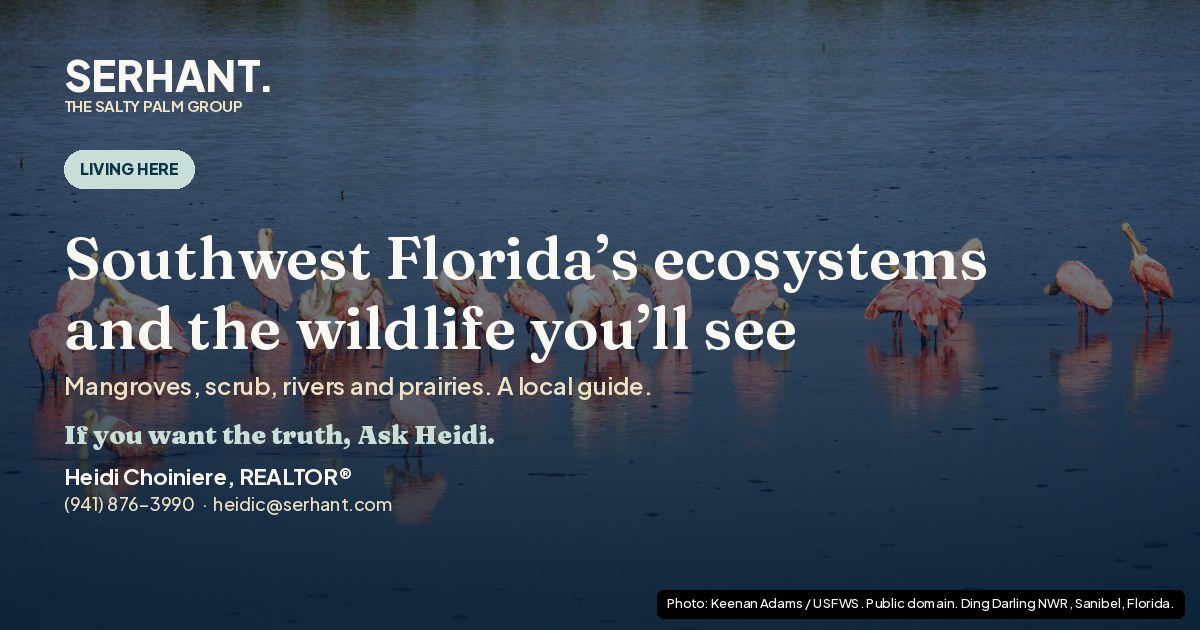
On Sanibel, Florida, J.N. “Ding” Darling National Wildlife Refuge is part of what the U.S. Fish and Wildlife Service calls the largest undeveloped mangrove ecosystem in the United States. It covers more than 6,400 acres and provides habitat for more than 245 species of birds, including roseate spoonbills photographed there by USFWS. Wildlife Drive, four miles long, is the usual way in. Go at low tide; it is closed on Fridays.
Beaches and barrier islands
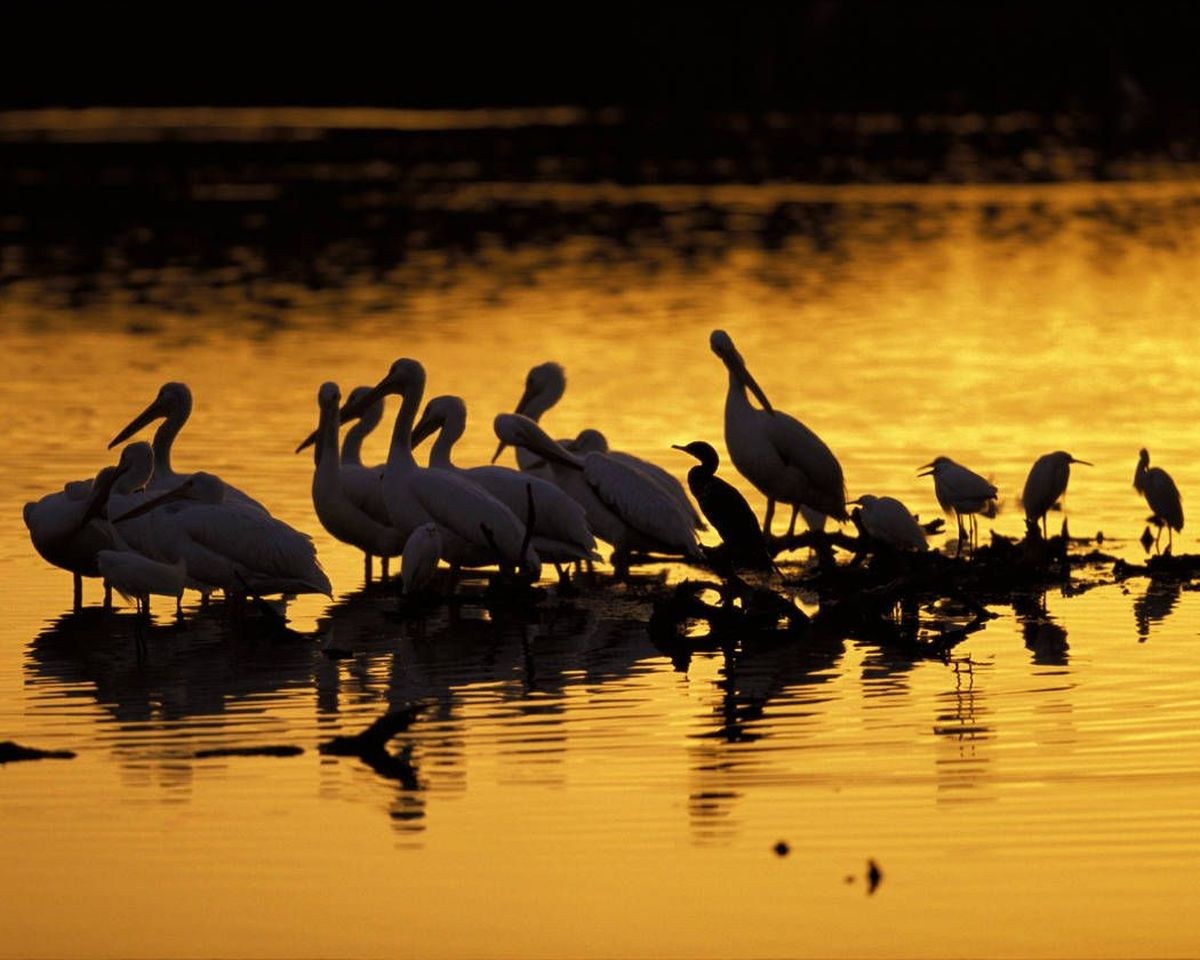
At the south end of Manasota Key, Stump Pass Beach State Park in Englewood, Florida, is a mile of beach where Florida State Parks says visitors might see manatees, gopher tortoises, snowy egrets, least terns and magnificent frigatebirds.
Those beaches are also nesting ground for sea turtles. Florida State Parks includes Stump Pass, Cayo Costa, Gasparilla Island and Lovers Key among the parks that survey nests from March 1 through October 31. If you see a roped-off nest, stay clear. If you live or stay on the beach, lighting matters. FWC’s “three golden rules” are to keep lights low, long-wavelength (amber, orange or red), and fully shielded so the bulb is not visible from the sand. Turn off decorative beach-facing lights, and close blinds at night.
Rivers, cypress and prairie
The Myakka River is Florida’s first state-designated wild and scenic river. It runs through Myakka River State Park east of Sarasota, Florida — more than 37,000 acres of wetlands, prairies, hammocks and pinelands. Florida State Parks describes a tea-colored river, with limpkins and ospreys calling and alligators and turtles sunning on the banks, plus bobcats, otters and more than 100 kinds of birds. More than half the park is Florida dry prairie, a mostly treeless community of grasses, palmetto and wildflowers that the park service calls the second-most biodiverse ecosystem in North America. Prescribed fire is how it is kept open.
The Peace River has a different feel — palmetto, cypress, cabbage palm and live oak along the banks, and high-water marks on the trees from seasonal floods. The water district notes that mangroves appear as the river nears the harbor, and that gopher tortoises use the sandy soil, sandhill cranes use the pastures, and limpkins hunt applesnails along the water. In DeSoto County, Brownville Park in Arcadia, Florida, is a 75-acre county park on the river with a boat ramp and trails through floodplain forest and hardwood hammock, and a cypress-lined stream.
Pine flatwoods, marshes and cypress domes
A lot of inland Southwest Florida is pine flatwoods: open slash pine, palmetto and seasonal wetlands. Fred C. Babcock/Cecil M. Webb Wildlife Management Area is the place to see that landscape at scale. FWC says more than half of the area is mesic and wet flatwoods, with depression marshes, dome swamps, seasonal ponds and wet and dry prairies mixed in. In the summer rainy season, much of it can flood for short periods. The open pine is home to colonies of red-cockaded woodpeckers; FWC marks their cavity trees with a white-painted ring, so you’ll know to give those trees space. The wildlife list also includes bald eagles, wood storks, sandhill cranes and the southern fox squirrel. FWC points to the canal along Seaboard Grade as a good place to look for wood storks and alligators. Closer to town, Sarasota County’s Celery Fields Regional Stormwater Facility in Sarasota, Florida, is a county wetland and stormwater area with trails, boardwalks and observation decks.
Florida scrub, where the scrub-jay still lives
Florida scrub and scrubby flatwoods are well-drained sandy soil, low shrubs, and not much shade — the habitat the Florida scrub-jay has to have. Florida State Parks says the scrub-jay is the only bird species found only in Florida, and that it lives in the lower shrubs, not up in tall pines. Without fire, taller plants crowd out that low scrub.
Oscar Scherer State Park in Osprey, Florida, covers 1,398 acres, and Florida State Parks calls it home to one of the only protected scrub-jay populations in southwest Florida. The same scrubby flatwoods are also home to gopher tortoises and eastern indigo snakes, and bald eagles nest in the park in winter. A tortoise burrow looks like a wide, sandy apron; along the Peace River, the water district notes that a burrow can be shared with more than 350 other animal species. If you find one on a lot you’re considering, leave it alone and ask before anyone clears the land.
What living near nature actually means
If you buy on a lake, pond or canal, assume alligators can be present. FWC says alligators live in all 67 Florida counties. Never feed one — that is illegal under Florida Administrative Code 68A-25.001 — and swim only in designated areas during daylight. Keep pets leashed and away from the water’s edge. If an alligator is a genuine concern, call FWC’s Nuisance Alligator Hotline at 866-392-4286.
If you boat, learn the manatee signs. FWC sets slow-speed, idle-speed and, in some places, no-entry zones to protect manatees. In summer they spread out through harbors and rivers; in winter they head for warm water. One local example is easy to get wrong: FWC restored habitat downstream of Warm Mineral Springs in North Port, Florida, as a winter warm-water refuge, but there is no public viewing there. The creeks are a no-entry zone from November 15 to March 15. For winter viewing, FWC lists Lee County Manatee Park in Fort Myers, Florida, on the Orange River and the Florida Power & Light discharge canal.
If you live on the beach, plan on turtle-friendly lighting during nesting season. If you have sandy, open land, you may be sharing it with gopher tortoises. None of this is a reason not to move here. It’s the reason a lot of people do. You just want to know the landscape before you pick a street.
A few rules cover almost every outing. Don’t feed wildlife — FWC says it teaches animals to lose their fear of people, and Florida rules also prohibit feeding bald eagles, pelicans and sandhill cranes. Give animals room, and watch with binoculars. If you see a manatee, look but don’t touch, don’t feed it or give it water, and don’t chase it. Harassment is any activity that changes the animal’s natural behavior, and manatees are protected by state and federal law. Stay off marked sea turtle nests. To report a dead or injured manatee or a wildlife violation, call 888-404-3922.
If you want help picking a place that still feels like this
When people tell me they want “nature, but also a grocery store,” they’re usually choosing among a few different landscapes, not just a few different towns. A home near the harbor is a different daily life than a home near scrub or a river floodplain. I’ll help you look at the streets, the parks you’ll actually use, and the practical pieces — flood, insurance, access — so you know what you’re moving next to.
If you want the truth, Ask Heidi: (941) 876-3990 or [email protected].
Common questions
Where can I see manatees in this area?
You may see manatees while paddling mangrove shorelines at Charlotte Harbor Preserve State Park near Punta Gorda, Florida, or at other harbor and river waters in warm months. For winter viewing, FWC lists Lee County Manatee Park in Fort Myers, Florida, on the Orange River and the Florida Power & Light discharge canal; call ahead. There is no public viewing at the Warm Mineral Springs winter refuge in North Port, Florida — that creek is a no-entry zone from November 15 to March 15. Watch from a distance, and do not feed, touch or chase manatees.
Is it legal to feed alligators or other wildlife?
No. Florida Administrative Code 68A-25.001 prohibits feeding alligators and crocodiles. FWC also prohibits feeding bald eagles, pelicans and sandhill cranes, and prohibits putting out food in a way that attracts bears, coyotes, foxes and raccoons. Feeding teaches animals to lose their fear of people and can lead to conflict. If an alligator is a genuine concern, call FWC’s Nuisance Alligator Hotline at 866-392-4286.
Where can I see Florida scrub-jays?
Oscar Scherer State Park in Osprey, Florida, has one of the only protected Florida scrub-jay populations in southwest Florida, according to Florida State Parks. The birds live in scrubby flatwoods — low, sandy habitat that depends on fire. Ask a ranger where they are being seen that week, and do not feed or approach them.
If I buy a home on a canal, pond or beach, what should I know?
Assume alligators can be present in lakes, ponds and canals; FWC says they live in all 67 Florida counties. Never feed them, swim only in designated areas during daylight, and keep pets leashed and away from the water’s edge. If you boat, obey posted manatee speed and no-entry zones and stay out of seagrass. If you live on a nesting beach, use turtle-friendly lighting from March 1 through October 31: lights that are low, long-wavelength (amber, orange or red), and fully shielded. If a gopher tortoise burrow is on a lot, leave it alone and ask before anyone clears the land.
SERHANT.
Heidi Choiniere, REALTOR®
FL License #SL3445168
The Salty Palm Group
(941) 876-3990 · [email protected]
Related guides from the journal
Sources
Checked November 21, 2026. This is general information, not legal advice, and not a guarantee you will see any particular animal on a given day. Park hours, fees, trail conditions and wildlife-protection rules can change; confirm details with the managing agency before you go, and give wildlife room.
- Southwest Florida Water Management District: Charlotte Harbor (second-largest estuary in Florida; 30 miles long by seven miles wide; 219 miles of shoreline; habitat mosaic and listed wildlife) and Ecological Diversity in the Peace River watershed (cypress and other bank vegetation, gopher tortoise burrows shared with more than 350 other species, sandhill cranes, limpkins, mangroves near the estuary).
- Florida Fish and Wildlife Conservation Commission: Mangrove Forests; Seagrass FAQ; Charlotte Harbor native habitats and animals boating-guide pages; Babcock/Webb habitat and wildlife; feeding wildlife (including Florida Administrative Code 68A-25.001 and related feeding rules); Living with Alligators and Crocodiles; manatee viewing guidelines; manatee protection zones; where to see manatees (Lee County Manatee Park); sea turtle lighting; and Warm Mineral Springs habitat restoration (no public viewing; no-entry zone November 15 to March 15). Wildlife Alert Hotline: 888-404-3922. Nuisance Alligator Hotline: 866-392-4286.
- Florida Aquatic Preserves / Florida Department of Environmental Protection: Gasparilla Sound-Charlotte Harbor Aquatic Preserve (seagrass species, snook and other fish, manatees, bottlenose dolphins, roseate spoonbills, ospreys, loggerhead sea turtles).
- Florida State Parks: Myakka River State Park and experiences; Myakka’s vast dry prairie; Charlotte Harbor Preserve State Park; Oscar Scherer State Park, experiences and park brochure; Stump Pass Beach State Park; and Monitoring Sea Turtle Nests in Florida’s State Parks (Stump Pass, Cayo Costa, Gasparilla Island and Lovers Key among surveyed parks; season March 1 to October 31).
- U.S. Fish and Wildlife Service: J.N. “Ding” Darling National Wildlife Refuge (largest undeveloped mangrove ecosystem in the United States; more than 6,400 acres; more than 245 bird species; Wildlife Drive closed Fridays; low tide recommended). Public-domain photographs: roseate spoonbills by Keenan Adams/USFWS and wading birds at sunset by George Gentry/USFWS.
- DeSoto County, Florida: Brownville Park & Boat Ramp, Arcadia, Florida (75-acre county park on the Peace River; floodplain forest and hardwood hammock trails; cypress-lined stream).
- Sarasota County, Florida: Celery Fields Regional Stormwater Facility facility directory (trails, boardwalks, observation decks).
- City of North Port, Florida: Warm Mineral Springs Park (historic warm mineral spring and city park). Wildlife viewing at the associated creek is not offered; see the FWC restoration notice above.