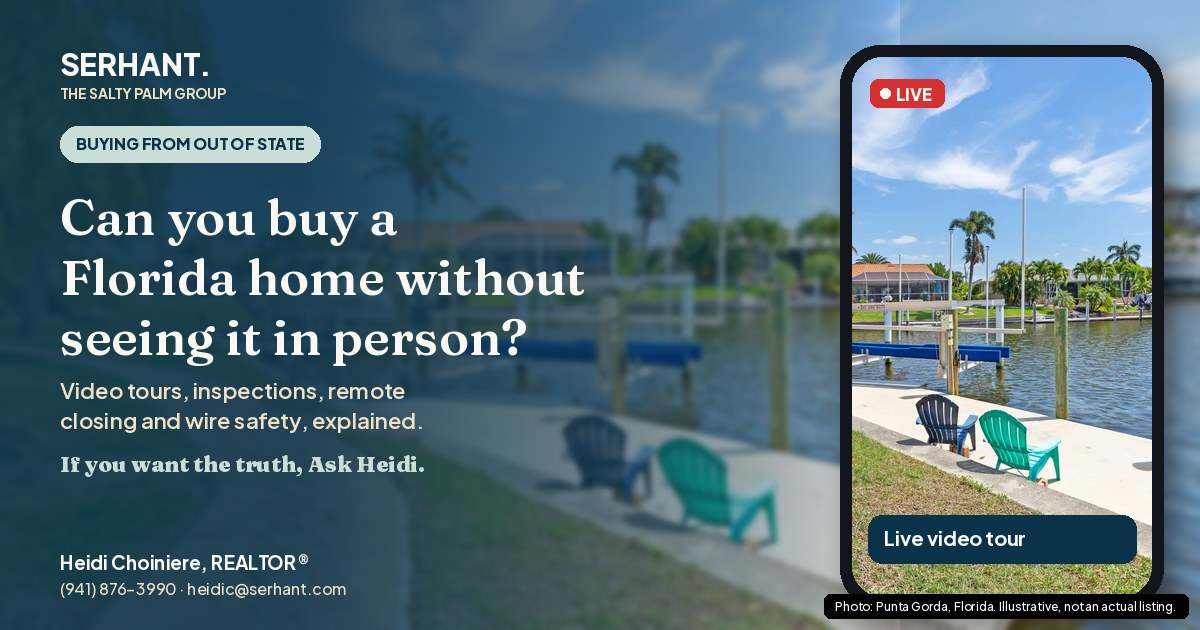
Maybe you’re in Ohio with a job you can’t leave yet. Maybe you’re in New York and the house you love just hit the market on a Tuesday. Either way, the question is the same: can you really buy a home in Southwest Florida without walking through it yourself? You can. Plenty of people do. But “I bought it off a video” only works when the person holding the phone is working for you, and when you check the things a camera can’t show you.
The short answer
Yes, you can buy a Southwest Florida home without seeing it in person, and in many cases you can close without flying down too. Florida law allows online notarization for signers who are out of state, and many title companies offer mail-away or online closings. What makes it work is the process: a live video tour where your agent shows you the bad stuff too, professional inspections inside your inspection period, your own homework on flood zone, insurance, taxes and association rules, and calling to verify every wire before you send a dollar. If any part of that gets skipped, slow down.
What changed on video tours since 2024
If you want an agent to walk a home for you on live video, expect to sign a written buyer agreement first. That isn’t a Florida law. It comes from the National Association of REALTORS® settlement practice changes that took effect August 17, 2024, and from MLS rules. Stellar MLS, the MLS used across much of Southwest Florida, defines touring to include an agent entering a home to give a live, virtual tour when the buyer isn’t physically there (Stellar MLS Rules, Article 06.01, last updated November 6, 2026).
Those agreements have to state what the agent will be paid, or how it will be figured, in a way that isn’t open-ended. They also have to say plainly that broker fees are not set by law and are fully negotiable. Everything else, like how long it lasts, whether it’s exclusive, and how either of you can end it, is a contract term you can talk through before you sign. I wrote a whole guide on questions to ask before hiring a buyer’s agent if you want the long version.
What a good live video tour actually looks like
Listing photos are marketing. They’re supposed to make the house look good. Stellar MLS rules say photos must present a “True Picture” of the property and that virtually staged photos must be labeled, but even honest photos leave things out. Your agent’s camera shouldn’t.
On a live tour, ask your agent to:
- Start outside. The roofline, gutters, the A/C unit, the driveway, the yard drainage, and the view from the front door in both directions.
- Show what’s next door. Many streets in North Port, Florida and the surrounding areas still have empty lots, and an empty lot can become a house. A canal-front view can change, too. Ask what you’re looking at, then look it up yourself.
- Open things. Under the sinks, the electrical panel, the water heater, closets, the garage ceiling. Water stains and soft spots don’t show up in a wide-angle photo.
- Run things. Faucets, the shower, the A/C, the pool pump, the garage door.
- Be quiet for a minute. Stand on the lanai with the sound on. Road noise, a pool equipment hum, a dog next door. A video with music over it hides all of that.
- Tell you what the camera can’t. Smell, humidity, how the floor feels. Ask directly, and ask for a straight answer.
You choose the area and the house based on what matters to you. A good agent helps you check facts like commute times, flood zones, association rules and permits. That’s research, not a sales pitch.
Do the homework a camera can’t do
Before you write an offer, or at least before your inspection period ends, line up the records:
- Flood zone: look up the address on FEMA’s Flood Map Service Center. Florida law requires sellers of residential property to give buyers a flood disclosure at or before the time the contract is signed, covering whether the seller knows of flood damage, filed a flood claim or got flood assistance. Read it closely. My flood insurance guide goes deeper.
- Insurance: get real quotes on the actual address, not a guess. Roof age, a four-point and a wind mitigation report all matter. See how to shop for homeowners insurance in Southwest Florida.
- Taxes and ownership: check the county property appraiser (Sarasota County and Charlotte County both have searchable sites). Don’t assume your taxes will match the seller’s. Your assessment can reset after you buy.
- Association and district fees: HOA rules, rental restrictions, pet rules and any community development district assessment. My Florida home costs guide covers what to ask.
- Licenses: you can look up any Florida real estate licensee, contractor or home inspector on the Florida Department of Business and Professional Regulation’s license search.
Inspections when you’re 1,000 miles away
You don’t have to be there for the inspection, but you should be on the phone afterward. Hire your own licensed home inspector, ask whether they’ll do a call or video walk-through of their findings, and read the whole report, not just the summary. In Southwest Florida, a four-point and a wind mitigation inspection can matter as much for insurance as for the house itself. Ask about a sewer or septic inspection, too, depending on the property.
Most Florida purchase contracts give you a set inspection period and a walk-through before closing, but deadlines are in calendar days and they move fast. I walk through how that works in what a buyer’s agent does during inspections. Read your own contract for the exact deadlines.
Closing from out of state
You have a few options, and your lender and title company decide which they’ll accept, so ask both early:
- Online notarization. Under Florida Statutes section 117.265, a Florida online notary can notarize documents for a signer who isn’t in Florida, using two-way audio-video and identity checks. The notary has to confirm you want a Florida notary and Florida law to apply.
- Mail-away closing. The title company sends the documents to you, and you sign in front of a notary where you live, and in some cases witnesses too, then ship them back. Ask exactly what has to be witnessed.
- Power of attorney. Someone signs for you. In Florida, a power of attorney has to be signed by you and two witnesses and acknowledged before a notary (section 709.2105). Lenders and title companies often have their own requirements on top of that, so don’t sign one until they’ve approved the form. A Florida real estate attorney can tell you whether it makes sense for you.
- Fly in for closing day. Some people still like to see the house before they sign, and that’s a perfectly good reason.
Wire fraud: call before you send anything
This is the one part I’m not relaxed about. Criminals break into or fake email accounts and send buyers “updated” wiring instructions that look exactly right. The FBI’s 2025 Internet Crime Report describes an August 2025 case where people closing on a home got an email impersonating their attorneys and wired more than $449,000. In that case, the FBI was able to get the bank to freeze the money, but you don’t want to count on that.
- Get the title company’s phone number at the start of the deal, from their official website or your contract, not from an email.
- Call that number and confirm the wiring instructions before you send any deposit or closing funds.
- Treat any “change” in wiring instructions as fake until you’ve confirmed it by phone.
- If something goes wrong, call your bank right away and report it at ic3.gov.
No one on your team should ever ask you to wire money based on an email alone.
When to slow down
Buying remotely works best when nobody’s rushing you. Slow down if you can’t get a live tour, if someone won’t show you a part of the house, if you’re asked to waive inspections to “stay competitive” before you understand what you’re giving up, or if anyone pressures you to wire money fast. A good deal will survive a phone call.
Common questions
Can I buy a house in Florida without seeing it in person?
Yes. Many buyers use a live video tour with their own agent, hire their own inspector, check flood, insurance, tax and association records, and close remotely. Ask your lender and title company early which signing options they accept.
Do I need to sign a buyer agreement for a virtual tour?
Usually, yes. Under NAR settlement practice changes in effect since August 17, 2024, and MLS rules such as Stellar MLS Article 06.01, an agent working with you needs a written agreement before touring a home, including a live virtual tour when you are not there. Fees in that agreement are not set by law and are fully negotiable.
Can I close on a Florida home from another state?
Often, yes. Florida Statutes section 117.265 lets a Florida online notary notarize for a signer located outside Florida. Many title companies also offer mail-away closings. Your lender and title company decide which methods they will accept for your transaction.
Can someone sign closing documents for me with a power of attorney?
It is possible. In Florida, a power of attorney must be signed by the principal and two witnesses and acknowledged before a notary (section 709.2105). Lenders and title companies often have their own requirements, so get their approval of the form first and ask a Florida real estate attorney whether it is right for you.
How do I avoid wire fraud when buying a home remotely?
Get the title company phone number at the start from a trusted source, call that number to confirm wiring instructions before sending any money, and treat any change in instructions as fake until you confirm it by phone. If something goes wrong, call your bank immediately and report it at ic3.gov.
SERHANT.
Heidi Choiniere, REALTOR®
FL License #SL3445168
The Salty Palm Group
(941) 876-3990 · [email protected]
Related guides from the journal
Sources
Checked November 20, 2026. This is general information, not legal advice. Florida law, NAR and MLS policies, and lender, title and contract terms are different things and can change; have a Florida real estate attorney review any agreement, contract or power of attorney before you sign.
- Stellar MLS: Stellar MLS Rules and Regulations (last updated Nov. 6, 2026): Article 04.04 (virtually staged photos, “True Picture”) and Article 06.01 (written buyer agreements; live virtual tours count as touring).
- National Association of REALTORS®: Written Buyer Agreements 101, Consumer Guide to Open Houses and Written Agreements and Consumer Guide: How to Protect Against Real Estate Wire Fraud.
- Florida Statutes (2026): Section 117.265 (online notarization procedures), Section 709.2105 (execution of a power of attorney) and Section 689.302 (seller flood disclosure).
- Federal Bureau of Investigation: 2025 Internet Crime Report (Internet Crime Complaint Center; BEC/real estate closing example, August 2025).
- FEMA: Flood Map Service Center.
- County property appraisers: Sarasota County Property Appraiser and Charlotte County Property Appraiser.
- Florida Department of Business and Professional Regulation: License search.